

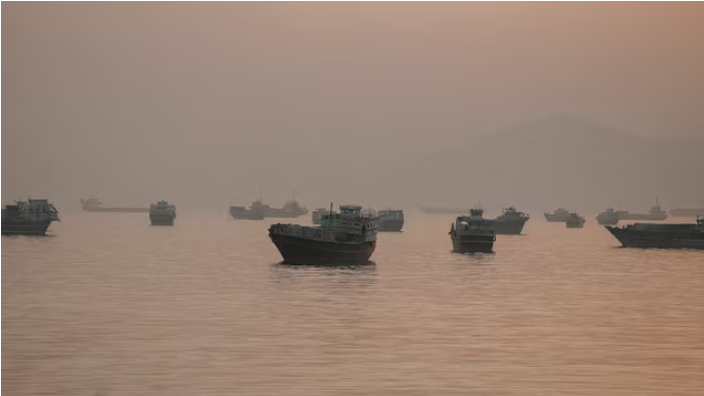
Fresh security concerns have emerged in the Strait of Hormuz after reports of attacks on commercial vessels renewed fears over the safety of one of the world’s busiest energy corridors. The latest incidents have drawn international attention, with governments and shipping companies closely monitoring developments that could affect global trade, oil supplies and maritime transportation. Reports say two commercial ships were damaged in the area, while a separate tanker caught fire after being struck by an unidentified projectile near the coast of Oman. No casualties have been reported so far.
A Critical Route for the World’s Energy Supply
The Strait of Hormuz connects the Persian Gulf with the Gulf of Oman and the Arabian Sea. It serves as a vital shipping lane for crude oil, liquefied natural gas (LNG) and other commercial cargo transported from major Gulf producers to markets across Asia, Europe and North America.
Energy analysts estimate that nearly one-fifth of the world’s oil consumption depends on shipments passing through this narrow waterway. Any disruption in vessel movement can quickly influence international energy prices and shipping costs.
Shipping Companies Review Safety Measures
Following the latest incidents, several international shipping operators have reportedly intensified safety protocols for vessels navigating through the region. Maritime security experts say commercial ships may be advised to alter sailing schedules, increase communication with naval authorities and follow designated transit corridors whenever possible.
Insurance providers are also expected to reassess risk premiums for ships entering high-risk waters, which could increase transportation expenses for global cargo operators.
Industry observers note that prolonged uncertainty may encourage some shipping companies to temporarily delay non-essential voyages until security conditions improve.
Oil Markets Watching Every Development
Global financial markets are keeping a close watch on the evolving situation. Even without a major disruption in oil exports, geopolitical uncertainty often influences crude oil prices because traders factor potential supply risks into the market.
Energy economists believe sustained instability in the region could increase transportation costs, affect fuel prices and create additional volatility in commodity markets.
However, experts also point out that oil prices will depend on whether shipping traffic continues without major interruptions over the coming days.
Diplomatic Efforts Face New Challenges
The reported attacks come at a time when diplomatic engagement between the United States and Iran remains fragile. Recent indirect discussions aimed at reducing regional tensions have not produced any publicly announced breakthrough, leaving uncertainty over future security arrangements in the Gulf.
Analysts believe maintaining freedom of navigation through the Strait of Hormuz will remain one of the key priorities for the international community, given its importance to global commerce.
Maritime Agencies Increase Surveillance
International maritime agencies have advised commercial vessels operating in the region to remain vigilant and immediately report any suspicious activity. Shipping operators are maintaining continuous contact with regional naval authorities while monitoring official advisories issued by maritime security organizations.
Several countries already maintain naval assets in nearby waters to safeguard commercial shipping and respond quickly to emergencies involving merchant vessels.
Global Supply Chains Could Feel the Impact
Although cargo movement through the Strait has not completely stopped, logistics experts warn that repeated security incidents can slow shipping operations even without a formal blockade. Longer transit times, additional inspections and higher insurance costs may eventually increase expenses across international supply chains.
Countries that depend heavily on imported oil and LNG are particularly sensitive to developments in the Gulf because energy transportation remains closely linked to industrial production and economic growth.
Situation Continues to Evolve
Authorities are continuing to gather information about the incidents, while independent verification of all claims is still underway. Maritime security agencies remain on alert, and governments are expected to closely monitor vessel movements through the Strait over the coming days.
With the Gulf remaining one of the world’s most strategically important maritime regions, the latest developments have once again highlighted how regional tensions can quickly influence international trade, energy security and the global economy.