

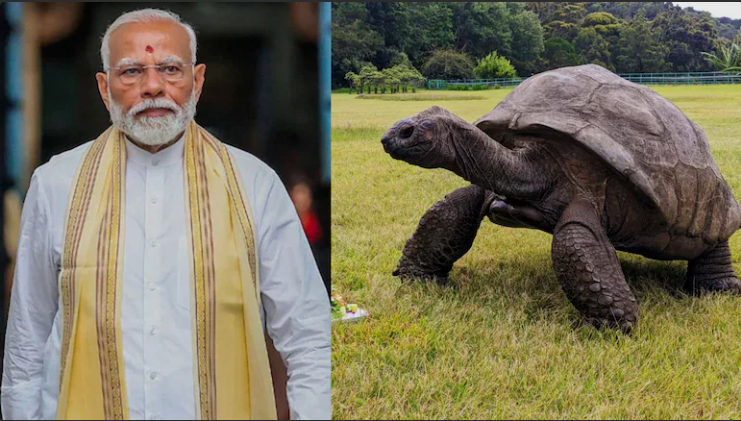
Prime Minister Narendra Modi’s upcoming visit to Seychelles is expected to strengthen India’s partnership with the island nation while reinforcing New Delhi’s growing focus on the Indian Ocean region. Beyond high-level diplomatic meetings and strategic discussions, one unique moment of the visit is likely to capture global attention—his interaction with Jonathan, the world’s oldest living land animal.
The visit comes at a significant milestone as India and Seychelles celebrate 50 years of diplomatic relations. Over the decades, the two countries have developed close cooperation in maritime security, economic development, disaster management, and environmental conservation. Officials believe the visit will provide fresh momentum to this long-standing partnership.
During his stay, Prime Minister Modi is scheduled to attend Seychelles’ National Day celebrations as the Guest of Honour. He is also expected to hold bilateral talks with the country’s leadership on issues ranging from regional security to sustainable economic growth. These discussions are likely to focus on expanding cooperation in areas that are increasingly important for both nations, including the blue economy, climate resilience, digital connectivity, and capacity building.
One of the highlights of the visit will be the Prime Minister’s stop at the Seychelles National Botanical Gardens. Besides planting a tree to promote environmental awareness, he is expected to meet Jonathan, the legendary giant tortoise believed to have been born in 1832. Having lived through nearly two centuries of world history, Jonathan has become an international symbol of longevity, resilience, and wildlife conservation.
Although advancing age has affected his eyesight and sense of smell, Jonathan continues to live under expert veterinary care and remains one of Seychelles’ most admired attractions. His remarkable lifespan has also attracted the attention of scientists studying ageing, animal health, and longevity. Researchers believe that understanding the biology of exceptionally long-lived animals may offer valuable insights into healthy ageing.
The tree-planting ceremony planned during the visit carries its own significance. India has consistently promoted global initiatives aimed at protecting biodiversity, increasing green cover, and encouraging sustainable development. By participating in this symbolic event, Prime Minister Modi is expected to reaffirm India’s commitment to environmental responsibility and international climate cooperation.
Experts also see the visit as an opportunity to deepen India’s presence in the western Indian Ocean. Seychelles occupies a strategically important location along key maritime routes, making cooperation between the two countries increasingly relevant in ensuring regional stability, maritime safety, and secure trade corridors. India has supported Seychelles through infrastructure development, defence cooperation, humanitarian assistance, and capacity-building programmes over the years.
Apart from strategic discussions, the visit is expected to strengthen people-to-people ties and promote collaboration in education, healthcare, tourism, and technology. Cultural exchanges and development partnerships have remained an important pillar of India-Seychelles relations, helping expand goodwill between the two nations.
The meeting with Jonathan is likely to become one of the most memorable moments of the Prime Minister’s visit, reflecting not only Seychelles’ rich natural heritage but also the shared commitment of both countries toward wildlife conservation and environmental protection.
As India and Seychelles mark five decades of diplomatic friendship, the visit is expected to open new avenues for cooperation while highlighting the importance of sustainable development, regional security, and ecological preservation. The combination of strategic dialogue and symbolic environmental initiatives is set to make the visit both diplomatically significant and globally noteworthy.